The nitrogen cycle explained
If there’s only one thing you ever understand about fishkeeping, make it this. The nitrogen cycle explains why a new tank is dangerous, why you have to “cycle”, and why the filter never switches off. Once this mechanism is clear, everything else falls into place.
The short version. Fish produce ammonia, a poison. Bacteria turn it into nitrite (also toxic), which other bacteria turn into nitrate (low toxicity), which you remove through water changes. Until these bacteria are established, the water is dangerous: that’s the whole point of cycling. Cycle complete = 0 ammonia, 0 nitrite, nitrate present.
The starting problem: ammonia
The moment a fish is alive (and eating), it produces waste, and uneaten food breaks down. All of this produces ammonia (NH3/NH4), a powerful poison, toxic even at low doses.
In a natural watercourse, ammonia is removed continuously by bacteria found everywhere. In a new tank, those bacteria don’t exist yet. So ammonia builds up… until it poisons the fish. It’s the number one cause of death in beginner tanks.
Nature’s solution: two groups of bacteria
The nitrogen cycle is the gradual establishment of two bacterial colonies that work in relay:
- Stage 1 — Nitrosomonas turn ammonia (NH3/NH4) into nitrite (NO2). Bad news: nitrite is still toxic.
- Stage 2 — Nitrobacter turn nitrite (NO2) into nitrate (NO3). Good news: nitrate is far less dangerous.
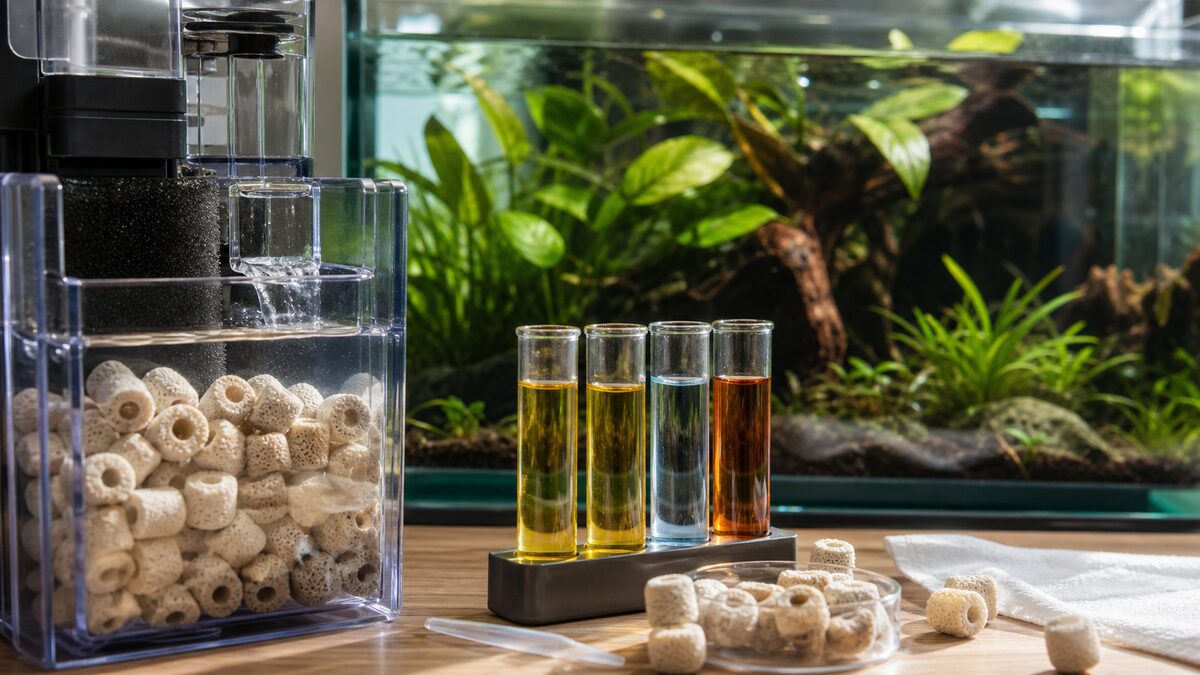
These bacteria live fixed in the filter and the substrate, not suspended in the water. That’s why the filter must run constantly (it oxygenates them) and why you never rinse it in chlorinated water.
Picture it as a chain: poison → less poison → almost harmless. Until the chain is complete, a toxic link builds up. Cycling is simply the time it takes for that chain to set itself up.
And the nitrate? Water changes
At the end of the chain, nitrate slowly accumulates. Low in toxicity at reasonable levels, it becomes a nuisance in large amounts (and feeds algae). You don’t convert it any further: you export it through regular water changes (typically 20–30% a week) and plants use up some of it.
| Compound | Source | Toxicity | How you get rid of it |
|---|---|---|---|
| Ammonia (NH3/NH4) | Waste, food | Very toxic | Bacteria → nitrite |
| Nitrite (NO2) | Stage 1 | Toxic | Bacteria → nitrate |
| Nitrate (NO3) | Stage 2 | Low toxicity | Water changes, plants |
How to know where you stand
Only a water test tells you. During cycling you see a typical wave: ammonia rises then falls, nitrite rises then falls, nitrate appears. The cycle is complete when, after dosing ammonia, you read 0 ammonia and 0 nitrite within 24h, with nitrate present.
To follow this wave, a liquid test kit (ammonia, nitrite, nitrate) is essential, strips lack accuracy on these critical readings. Here’s our pick:
Liquid test kit (NH3 · NO2 · NO3)
Our pick- Reads all three links of the chain: ammonia, nitrite, nitrate
- Liquid-drop accuracy where strips fall short
- Essential for confirming "0 ammonia, 0 nitrite" before the fish
Amazon affiliate link. Price and availability may change at any time.
- I understand the chain: ammonia → nitrite → nitrate
- My filter runs non-stop (it houses the bacteria)
- I never rinse the filter in chlorinated tap water
- I test to confirm 0 ammonia / 0 nitrite before the fish
- I do regular water changes to remove nitrate
- I don't add too many fish at once (the colony has to keep up)
Maintaining the cycle over time
Once established, the cycle looks after itself as long as you don’t break the bacterial colony:
- filter always running;
- no sudden overstocking (otherwise ammonia outpaces what the bacteria can handle);
- gentle cleaning (rinse the media in tank water).
Adding too many fish at once triggers a “mini-cycle”: an ammonia spike while the bacteria multiply. Hence the rule of adding fish gradually.
Conclusion
The nitrogen cycle is nothing mysterious: it’s a chain of bacteria that turns a poison into a manageable compound. Understanding it means understanding why you cycle, why the filter never stops, and why you change the water. It’s the bedrock of everything else.
To put it into practice, see « How long to cycle a 54L tank? » and « Should you run the filter before adding fish? ».
Frequently asked questions
What is the nitrogen cycle in an aquarium?
It's the process by which bacteria convert the fish's toxic waste (ammonia) into less harmful compounds. Ammonia becomes nitrite (toxic), then nitrate (low toxicity), which you remove through water changes. It's the foundation of a healthy tank.
Why is the nitrogen cycle so important?
Because without it, the ammonia produced by the fish builds up and poisons them. The cycle's bacteria are what make the water liveable in the long term. An 'uncycled' tank is one where these bacteria aren't established yet.
How do I know the nitrogen cycle is complete?
The cycle is complete when your tests read 0 ammonia, 0 nitrite, and nitrate present. That's proof both groups of bacteria are in place and processing the waste all the way through.
How do you maintain the nitrogen cycle?
Once established, the cycle looks after itself as long as the filter runs non-stop and you don't kill the bacteria (no rinsing in chlorinated water, no sudden overstocking). You remove the accumulated nitrate with regular water changes.