How many platies in 60 litres?
Transparency: this article contains Amazon affiliate links. If you buy through them, we earn a small commission at no extra cost to you — it never influences our advice. Learn more
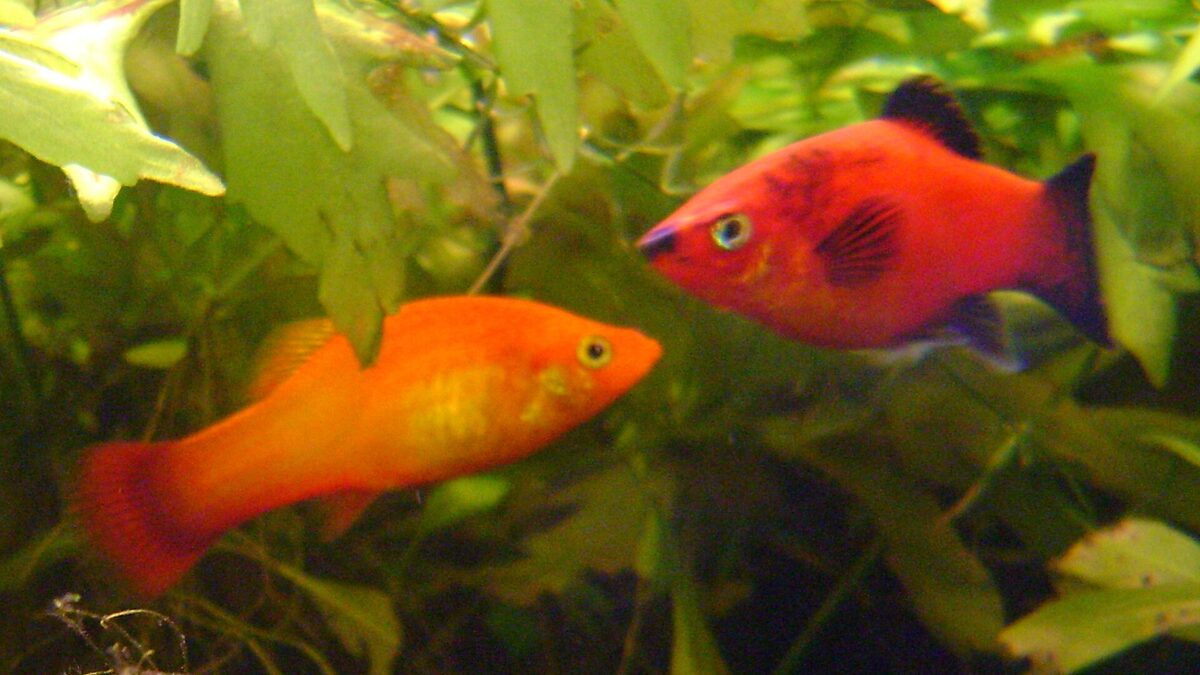
The platy is a bit like the guppy’s stocky, laid-back cousin: just as colourful, but hardier, with tougher fins, and genuinely easy-going. So, naturally, we get asked the same question as for its cousin: “I’ve got a 60-litre tank — how many can I put in?”
The answer comes down to one number, but as with all livebearers, the real issue lies elsewhere: what your group will look like three months from now.
The essentials. In a cycled, filtered and planted 60-litre tank, allow 5 to 7 adult platies. For a mixed group, start lower (4–5), with 1 male to 2–3 females, because births quickly push the numbers up. Platies like fairly hard water (pH 7–8), heated to between 22 and 26 °C, and a diet with a good share of plant matter.
The right number in 60 litres
The platy is chunkier than the guppy: the female reaches 5 to 6 cm, the male around 4 cm. It eats more, produces more waste and swims a lot. That’s why you keep fewer of them than guppies in the same volume.
| Setup | Suggested number in 60 L | Note |
|---|---|---|
| Males only | 6–7 | Colourful, no breeding, little squabbling |
| Females only | 5–6 | Calm, but often already pregnant when bought |
| Mixed (1 male / 2–3 females) | 4–5 to start | Breeding: the population will grow |
These figures assume a cycled tank, suitable filtration and a few plants. It isn’t just the volume that sets the limit, it’s the tank’s capacity to process waste — hence the point of starting low. For other volumes, the calculator further down the page gives you a cautious range.
Why 60 litres is the right starting point
The platy is lively and uses the whole tank, from the bottom to the surface. Below 54 litres, it lacks swimming space and the water soon becomes unstable once the fish start breeding. A standard 60-litre tank (60 cm long) is therefore the ideal size for a first group.
If you’re starting from scratch, a complete kit of this size brings the essentials together in one go:
Complete 60 L aquarium kit
Our pick- Volume suited to a group of 5 to 7 platies
- Filter and lighting sized for the tank
- Simpler, and often cheaper, than buying piece by piece
- Heater not always supplied: check the description
- The stock lighting can be borderline for demanding plants
Amazon affiliate link. Price and availability may change at any time.
The heater, on the other hand, is essential in most homes: see what wattage heater to choose for a tank this size.
Males and females: the ratio that keeps the peace
You can tell a male platy by his gonopodium, a thin, pointed anal fin; the female is bigger and rounder, with a fan-shaped anal fin. The male courts relentlessly: so the females don’t wear themselves out, keep 1 male to 2 to 3 females.
The classic trap: buying "females only" to avoid babies. A female platy sold in a shop has very often mated already, and she can store sperm for several broods. If you really don't want fry, the only reliable option is a males-only group.
The water they like
The platy comes from Mexico and Central America, where the water is fairly hard and slightly alkaline:
- temperature: 22 to 26 °C (the variatus platy tolerates slightly cooler water);
- pH: 7 to 8;
- hardness: medium to high (GH of around 10 to 25).
Across much of England — London, the South East and East Anglia especially — the hard tap water suits it very well once treated with a water conditioner. There’s no point trying to soften it: our article on hard tap water explains why that’s only worthwhile for certain species. To find out where you stand, a hardness test settles the question in a few minutes:
GH/KH hardness test
Our pick- Measures general hardness (GH) and carbonate hardness (KH)
- Liquid drop tests, more accurate than strips
- Useful for choosing species that suit your water
- Doesn't measure nitrite or nitrate: you still need a full test kit
Amazon affiliate link. Price and availability may change at any time.
Feeding: think green
The platy is an omnivore with a leaning towards plants. It spends part of the day grazing algae off the décor and the glass, which makes it a handy little helper with maintenance. In practice:
- a staple of spirulina flakes or livebearer pellets;
- 2 to 3 times a week, frozen foods (brine shrimp, daphnia);
- one or two small feeds a day, as much as they eat in 1 to 2 minutes.
Spirulina flakes
Our pick- Rich in plant matter, suited to the diet of platies and mollies
- Help with good digestion
- Combine well with standard livebearer food
- Not enough on their own: alternate with protein
Amazon affiliate link. Price and availability may change at any time.
Breeding: plan ahead before it gets out of hand
Like the guppy, the platy is a livebearer: a female gives birth to 20 to 50 fry roughly every 4 weeks. Platy fry are a little bigger than guppy fry, and in a planted tank a good number of them survive. A group of 4 platies can therefore pass 20 fish within a few months.
Three strategies, from the simplest to the most hands-on:
- Males only: zero fry, zero hassle.
- Mixed group in a planted tank: the adults eat some of the young, so numbers rise more slowly — but they do rise.
- A deliberate mixed group: you regularly hand the young on to a club, to other fishkeepers or to a shop. Never release them into the wild.
Worth knowing: the platy readily crossbreeds with the swordtail (same genus, Xiphophorus), a bigger fish that needs at least 100 litres. It doesn’t, however, crossbreed with the guppy or the molly.
Before your platies arrive
- My tank is cycled: 0 ammonia and 0 nitrite when tested
- Heater set between 22 and 26 °C, thermometer in place
- I've decided: males only or a ratio of 1 male to 2–3 females
- I've checked my water hardness (fairly hard water = ideal)
- A few plants and hiding places are in place
- I have a plan for the fry (if it's a mixed group)
For a first tank, the platy may be even more forgiving than the guppy: short fins, a hearty appetite, and more tolerance of small beginner mistakes. We hold back half a point for its breeding, which you need to plan for from the start. With a group of colourful males, it makes one of the simplest and most cheerful tanks there is.
Conclusion
In a 60-litre tank, aim for 5 to 7 adult platies, and start lower with a mixed group. Fairly hard, heated water, a plant-rich diet, a ratio of one male to two or three females: the platy asks for nothing more. The only real decision to make is about breeding.
The platy shares almost all of the guppy’s needs: to go further, read our complete guppy care guide, or compare with how many guppies in 60 litres. And if you’re still unsure about the size of your future tank, see which tank size is best for beginners.
How many fish in my tank?
Enter your tank volume and the species you want — we give a cautious estimate.
Indicative estimate. It also depends on filtration and plants, and assumes a cycled tank. When in doubt, stock less: animal welfare comes first.
Frequently asked questions
How many platies can you keep in a 60-litre tank?
Allow 5 to 7 adult platies in a cycled, filtered and planted 60-litre tank. For a mixed group, start with 4 or 5 instead (1 male to 3 females, for example), as births will soon push the numbers up.
Can you keep platies and guppies together?
Yes, they like the same hard water and share the same peaceful temperament. They don't interbreed. You simply need to reduce the number of each so you don't overstock the tank: in 60 litres, for example, 3 platies and 4 or 5 guppies.
Do platies need a heater?
Yes, in most homes. Platies are happy between 22 and 26 °C and, above all, appreciate a stable temperature. The variatus platy tolerates slightly cooler water, but a thermostatic heater is still the best safeguard against swings.
How many babies does a platy have?
A female platy usually gives birth to 20 to 50 fry roughly every 4 weeks, sometimes more in a large female. As with guppies, she can store sperm and produce several broods in a row from a single mating.