Best water test kit for aquariums: which to choose?
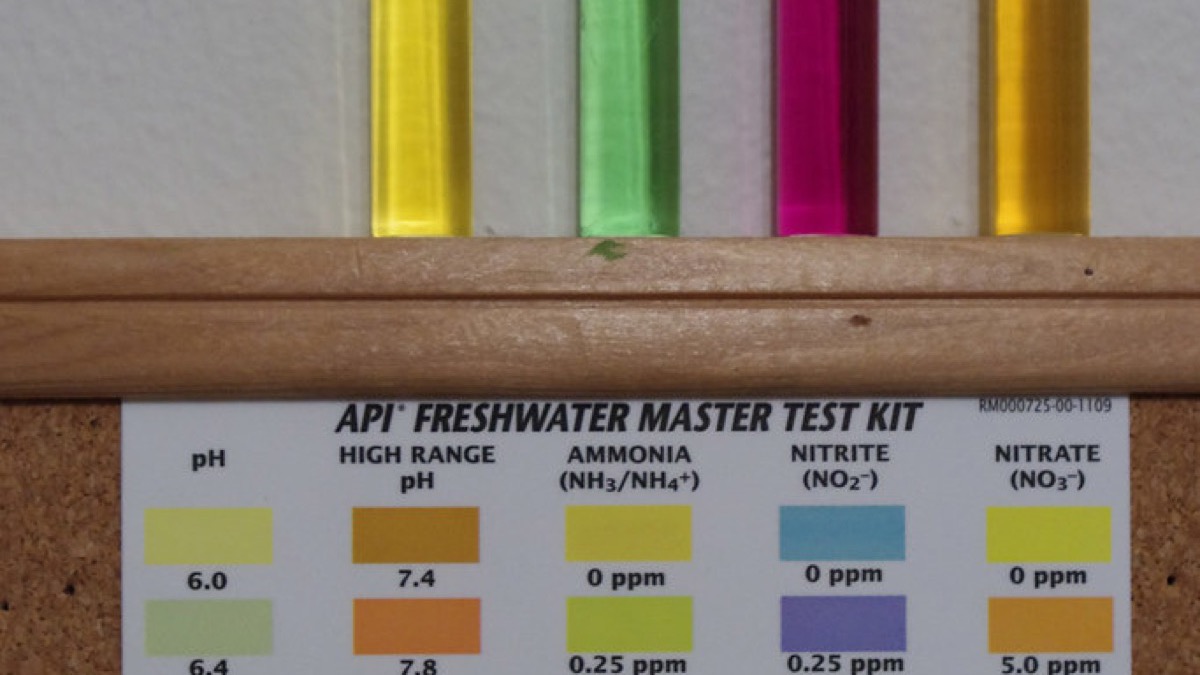
It’s the tool that tells you the truth about your water — and the one too many beginners skip. A water test kit turns the hobby from “I guess” into “I know”, especially during cycling. The question that remains: which type to choose, strips or drops?
The essentials — how to choose. For reliable results, choose a liquid drop kit (liquid reagents) over strips, especially for tracking the cycle. The essential parameters: ammonia, nitrite, nitrate (the cycle trio) + pH, and depending on your fish, GH/KH. Check the expiry date of the reagents. It’s one of the very first things to buy.
Strips or drops?
| Criteria | Test strips | Liquid drop test |
|---|---|---|
| Accuracy | Approximate | Good, reliable |
| Ammonia / nitrite | Often unreliable | Reliable (crucial during cycling) |
| Speed | Very fast | A few minutes |
| Cost in use | Variable | Economical (lots of tests) |
| Ideal use | Quick glance | Important decisions |
The verdict is clear: for the decisions that count (is the tank cycled? can I add fish?), drops are essential. Strips can do for a rough check, but don’t rely on them for ammonia and nitrite.
The liquid drop test is, along with water conditioner, the best-value purchase a beginner can make. It prevents the fatal mistake: adding fish to a tank that isn't cycled yet. Five minutes of testing beats a whole tank of lost fish.
Which parameters to test
- Ammonia (NH3/NH4): poison number one, to watch at start-up. Should read 0.
- Nitrite (NO2): toxic, the intermediate stage of the cycle. Should read 0.
- Nitrate (NO3): barely toxic, kept in check with water changes.
- pH: the acidity of the water, useful depending on the species.
- GH / KH: the hardness, important for choosing fish and for pH stability.
A complete kit brings these parameters together. To start, the ammonia/nitrite/nitrate + pH trio is the minimum.
For the decisions that count, the liquid drop kit is our pick:
Complete liquid drop test kit
Our pick- Reliable on ammonia and nitrite, crucial during cycling
- Covers the cycle trio + pH (often GH/KH too)
- Economical in use: lots of tests per bottle
Amazon affiliate link. Price and availability may change at any time.
For a quick glance as a supplement, strips will do in a pinch:
Test strips
The fastest- Result in a few seconds
- Handy for a routine glance
- Several parameters on a single strip
Amazon affiliate link. Price and availability may change at any time.
Before you buy, keep these benchmarks in mind:
- I prioritise a liquid drop kit for reliability
- It measures ammonia, nitrite, nitrate (the cycle trio)
- It also measures pH (and GH/KH depending on my fish)
- I check the expiry date of the reagents
- I store the bottles away from heat and light
- I test mostly during cycling and after any change
If I could keep only one measuring accessory, it would be the complete liquid drop kit. It's there for everything: cycling, adding fish, diagnosing a water problem. The strips, I keep for an express glance. To decide, it's the drops.
Conclusion
The “best” water test kit is a liquid drop kit measuring ammonia, nitrite, nitrate and pH (plus GH/KH depending on your fish). It’s the aquarist’s tool of truth, essential for cycling and diagnosis. Check the expiry date, store it well, and get into the habit of testing: you’ll never be flying blind again.
To understand what these tests reveal, see “The nitrogen cycle explained” and “How long to cycle a 54L tank?”.
Frequently asked questions
Test strips or a liquid drop test for the aquarium?
Liquid drop tests (liquid reagents) are much more accurate and reliable than strips, especially for ammonia and nitrite during cycling. Strips will do for a quick glance, but for important decisions you rely on the drops.
Which parameters should I test in an aquarium?
The essentials are ammonia (NH3/NH4), nitrite (NO2) and nitrate (NO3) — especially at start-up — plus pH. Depending on the fish, you add GH and KH (hardness). A complete kit covers these key parameters.
Which water test should I use to track cycling?
A liquid drop kit measuring ammonia, nitrite and nitrate is essential for tracking cycling. It's the only reliable way to know where the cycle is and when the tank is ready for fish.
Do water tests have an expiry date?
Yes, the reagents lose reliability over time. Check the date, store the bottles away from heat and light, and replace a kit that's too old: an expired test can give false readings and lead to bad decisions.