Goldfish: why not a bowl (and what tank size)?
Transparency: this article contains Amazon affiliate links. If you buy through them, we earn a small commission at no extra cost to you — it never influences our advice. Learn more
It’s probably the most deeply rooted image in fishkeeping: a goldfish circling a bowl on top of a chest of drawers. It’s also one of the worst ideas there is for the fish. This isn’t a matter of taste or fashion: a bowl simply can’t keep the water fit for this fish to live in.
The good news: properly housed, the goldfish is a hardy, endearing and surprisingly intelligent animal that can live for more than ten years. Here’s why a bowl is a dead end, and what a goldfish really needs.
The essentials. A goldfish shouldn’t live in a bowl: no filtration, too little oxygen, and a volume of water that poisons itself within days. For fancy goldfish, allow at least 100 litres for 1 or 2, then 50 litres more per fish. Common and comet goldfish (over 20 cm as adults) belong in a pond or an aquarium of at least 300 litres. Goldfish need powerful filtration, cool water (15–24 °C) and company.
Why a bowl is a dead end
The goldfish (Carassius auratus) produces a lot of waste: it eats a lot and gives off a lot of ammonia. In a bowl, everything works against it:
- No filtration: toxic ammonia and nitrite build up within days. Without the bacteria in a filter, nothing removes them — that’s the whole principle of the nitrogen cycle.
- Too little oxygen: a round bowl offers only a tiny surface area in contact with the air, while the goldfish uses a lot of oxygen.
- A tiny volume: the temperature and water quality change abruptly at the slightest slip.
- Stunted growth: contrary to popular belief, the fish doesn’t “adapt” to the size of its bowl. Its growth is held back by poor water quality, which goes hand in hand with fragile health and a much shorter life.
Nor does the goldfish have a “three-second memory”: experiments have shown it can retain information for several months. It isn’t an ornament, it’s an animal that recognises its surroundings — and the person who feeds it. In fact, the city of Rome banned goldfish bowls back in 2005.
What tank size for a goldfish?
It all depends on the type of goldfish. There are two main families:
| Type | Adult size | Recommended volume | Note |
|---|---|---|---|
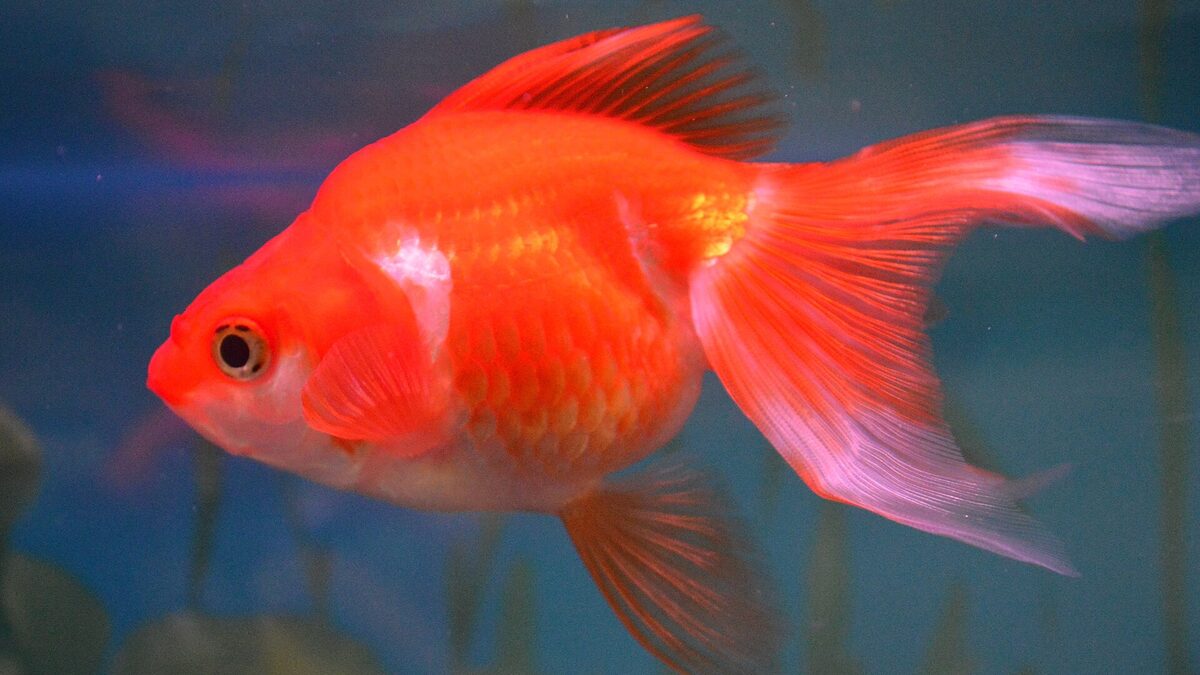
| Fancy (veiltail, oranda, ryukin, telescope eye…) | 15–20 cm | 100 L for 1–2, +50 L per fish | Round body, slow swimmers |
| Common, comet, shubunkin | 20–30 cm and over | Pond, or a 300 L aquarium minimum | Fast swimmers, very large |
For a specific volume, the calculator further down the page gives you a cautious range for fancy goldfish. The goldfish is also sociable: it does better in a pair or more than on its own.
Shape matters as much as litres: choose a long, low aquarium over a tall, narrow one. The surface area in contact with the air — and so the oxygenation — will be all the better for it.
For two fancy goldfish, a 100 to 120-litre kit is the right starting point:
100 to 120 L aquarium kit
Our pick- The realistic minimum volume for fancy goldfish
- Lid, lighting and filter supplied
- No heater needed for this species
- The stock filter is often a little undersized for goldfish: plan to upgrade it
- Over 100 kg once filled: a suitable cabinet is essential
Amazon affiliate link. Price and availability may change at any time.
Filtration: what really makes the difference
This is the one point you don’t compromise on with goldfish. Choose a filter rated for a much larger volume than your tank: for a 100-litre tank, a filter designed for 150 to 200 litres is no luxury. An external filter is often the best choice, for its capacity and robustness. Our guide to the best filter for a 100L aquarium compares the options.
External filter for 150 to 250 L aquariums
Our pick- Large volume of filter media for the beneficial bacteria
- High, adjustable flow for well-circulated, oxygenated water
- Quiet and discreet, tucked away in the cabinet
- More expensive and longer to set up than an internal filter
- Slightly more technical maintenance (hoses, seals)
Amazon affiliate link. Price and availability may change at any time.
And as with any aquarium, the tank must be cycled before the fish arrive: allow several weeks, as explained in how long it takes to cycle a tank.
Water, décor and tank mates
- Temperature: 15 to 24 °C or so. No need for a heater indoors, but beware of heatwaves: see how to cool your tank in summer.
- pH: 7 to 8, moderately hard water: most tap water treated with a water conditioner is fine.
- Décor: goldfish dig in the substrate and nibble soft plants. Go for tough plants such as Anubias and Java fern — see our easy plants with no CO2 — sand or gravel with no sharp edges, and few pointed objects that could damage their fins.
Don't mix goldfish with tropical fish: they don't like the same temperature, and an adult goldfish won't think twice about swallowing a neon or a guppy. Also avoid mixing common and fancy goldfish: the much faster commons snap up all the food before the fancies have had time to swim over to it.
Feeding: less than you think
Goldfish beg for food all the time: it’s not a sign of hunger, it’s just their nature. Overfeeding is the most common mistake, and it fouls the water very quickly. A good routine:
- 1 to 2 small feeds a day, as much as they eat in 1 to 2 minutes;
- a goldfish-specific food, ideally sinking pellets for the round-bodied varieties, so they gulp less air at the surface;
- a little plant matter (shelled, blanched peas, blanched spinach) once or twice a week.
Sinking goldfish pellets
Our pick- Formula suited to coldwater fish
- The pellets sink: less air gulped at the surface
- Easy to portion, with fewer leftovers than flakes
- Supplement with plant matter for a balanced diet
Amazon affiliate link. Price and availability may change at any time.
Already have a goldfish in a bowl?
Don’t panic: lots of goldfish arrive this way, won at a funfair or given as a present. While you wait for a proper aquarium:
- Move it to the largest clean container you can find (a food-grade plastic storage box holding a few dozen litres will do for a few days).
- Change some of the water every day, using tap water treated with a water conditioner and at the same temperature.
- Feed very little — a pinch a day is enough.
- Set up the aquarium and its filter as soon as possible, bearing in mind that cycling will take a few weeks: keep up the frequent water changes in the meantime.
Before you get a goldfish
- I have an aquarium of at least 100 L for 1 or 2 fancy goldfish
- The filter is rated for a bigger volume than the tank
- The tank is cycled: 0 ammonia and 0 nitrite when tested
- I'm planning at least two fish, not just one
- No tropical fish in the same tank
- I'm in it for the long haul: a goldfish can live more than 10 years
In a proper aquarium, the goldfish is a lovely surprise: it recognises the hand that feeds it, shows real curiosity and lives for years. We take off a point because it's far more demanding than its reputation suggests: a big volume, beefy filtration, regular maintenance. It's not the "easy little fish" people imagine, but it's a companion for the long term.
Conclusion
A bowl isn’t a mini aquarium: it’s a container where the water poisons itself within days. A fancy goldfish needs at least 100 litres for one or two, 50 litres more per fish, powerful filtration and cool, well-oxygenated water. Common goldfish, for their part, belong in a pond. Housed like this, a goldfish will be with you for more than ten years.
To choose the size of your future tank, see which tank size is best for beginners. And to keep an eye on the water, read our guide to the best water test kit.
How many fish in my tank?
Enter your tank volume and the species you want — we give a cautious estimate.
Indicative estimate. It also depends on filtration and plants, and assumes a cycled tank. When in doubt, stock less: animal welfare comes first.
Frequently asked questions
Can a goldfish live in a bowl?
It can survive in one for a while, but not live there properly. A bowl has no filtration, very little surface area in contact with the air and a tiny volume: waste builds up within days, oxygen runs short and the temperature keeps swinging. The fish weakens and its life is drastically shortened.
What size tank does a goldfish need?
For ‘fancy’ goldfish (veiltail, oranda, ryukin…), allow at least 100 litres for one or two, then around 50 litres more for each extra fish. Common and comet goldfish, which grow beyond 20 cm, belong in a garden pond or a very large aquarium of at least 300 litres.
Does a goldfish need a heater?
No, not in most homes. The goldfish is a coldwater fish that's happy at around 15 to 24 °C. It does, however, need well-oxygenated, filtered water, and it copes badly with summer heatwaves.
How long do goldfish live?
Well kept, a goldfish usually lives 10 to 20 years, sometimes longer. Lifespans of a few months or a year or two almost always come down to poor conditions: a bowl, unfiltered water, overfeeding.
Can you keep goldfish with tropical fish?
It's not recommended. Goldfish prefer cooler water than tropical fish, produce a lot of waste and can swallow small fish such as neons or guppies. A goldfish-only tank is the better option.