How many mollies in 80 litres (and what water)?
Transparency: this article contains Amazon affiliate links. If you buy through them, we earn a small commission at no extra cost to you — it never influences our advice. Learn more
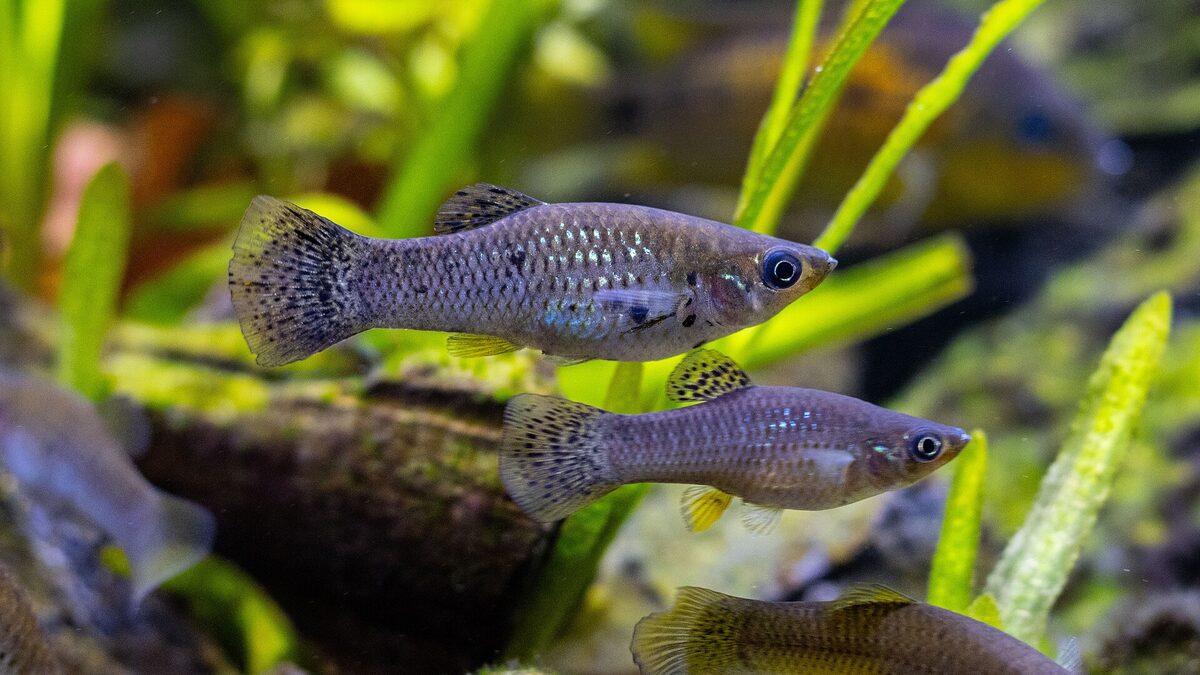
The molly has everything going for it: an elegant shape, black, dalmatian or gold colour forms, a peaceful nature and a voracious appetite for algae. But it’s also the livebearer you most often see waste away in a tank that doesn’t suit it.
The reason comes down to two words: volume, and above all water. The good news: if your tap water is hard, you’re already halfway there.
The essentials. In a well-filtered 80-litre tank, allow 4 to 5 adult common mollies, with at least 2 to 3 females per male. Sailfin mollies, which grow bigger, need 120 L or more. Mollies demand hard, alkaline water (pH 7.5–8.5, GH 15+), heated to between 24 and 28 °C, and a plant-rich diet. Salt isn’t necessary.
The right number of mollies in 80 litres
The molly is a much bigger fish than the guppy or the platy: the common molly (Poecilia sphenops and its captive-bred forms, often hybrids: black, dalmatian, gold…) reaches 6 to 8 cm, and large females a little more. It eats a lot, and produces waste to match.
| Setup in 80 L | Suggested number | Note |
|---|---|---|
| Common mollies, mixed group | 4–5 (1 male + 3–4 females) | Breeding will push the numbers up |
| Common mollies, males or females only | 4–5 | Females often already pregnant when bought |
| Mollies + platies or guppies | 3 mollies + 4–5 platies/guppies | Same hard water, same needs |
| Sailfin mollies (P. latipinna, P. velifera) | Avoid | Too big: 120 L minimum |
For another volume, the calculator further down the page gives you a cautious range. Bear in mind that 80 litres is a minimum for mollies: below that, the water deteriorates too quickly with a fish of this size.
Water: the deciding factor
In the wild, mollies live in hard, alkaline, sometimes slightly brackish water. In soft or acidic water, they weaken, stop eating and eventually fall ill. Their needs:
- temperature: 24 to 28 °C;
- pH: 7.5 to 8.5;
- hardness: high (GH of 15 °dGH or more).
Across much of England — London, the South East and East Anglia especially — tap water is naturally hard: exactly what mollies need. Simply treat it with a water conditioner, and whatever you do, don’t soften it — our article on hard tap water explains why that limescale, the enemy of some species, is an asset here. To know for sure, measure the hardness:
GH/KH hardness test
Our pick- Measures general hardness (GH) and carbonate hardness (KH)
- The most useful test for a molly tank
- Liquid drop tests, accurate and economical
- Needs pairing with a nitrite and nitrate test
Amazon affiliate link. Price and availability may change at any time.
If your water is soft (in Scotland, Wales, North West England or Devon and Cornwall, for example), you can harden it, for instance with a little coral sand in the filter or remineralising salts. Go gradually, checking the pH and hardness at each step.
What about salt?
It’s a stubborn old piece of advice: “mollies need salt”. In reality, they tolerate slightly brackish water, but they don’t need it in hard fresh water. Salt does nothing for a well-kept molly, and it bothers plants as well as most other fish.
The right kit for an 80-litre tank
With such a greedy fish, two pieces of equipment make all the difference:
- generous filtration, rated a little above the tank’s volume — our guide to the best filter for a 100L aquarium also works very well for a heavily stocked 80 L;
- a reliable heater, because mollies like fairly warm and, above all, stable water.
100 W thermostatic heater
Our pick- Comfortable wattage for 80 to 100 litres
- Adjustable thermostat for a stable temperature
- Prevents the cold snaps that weaken mollies
- Oversized for a small tank: keep it for 80 L and up
- A separate thermometer is still advisable to check the setting
Amazon affiliate link. Price and availability may change at any time.
For more on choosing a model, see our guide to the best aquarium heater.
Males, females and breeding
You can tell a male molly by his gonopodium (a thin, pointed anal fin); the female is bigger and rounder, with a fan-shaped anal fin. As with all livebearers, the male courts relentlessly: keep at least 2 to 3 females per male.
Breeding follows the familiar livebearer pattern: a female gives birth roughly every 4 to 6 weeks, usually to 20 to 60 fry, and more in a large female. In a planted tank, many of them survive, and an 80-litre tank fills up fast. Plan from the outset to hand the young on to a club, to other fishkeepers or to a shop, and never release them into the wild.
Choose your molly to suit your tank, not the other way round. For an 80-litre tank, stick to common mollies (black, dalmatian, gold…). The magnificent sailfin mollies grow much bigger. And we advise against "balloon" mollies: their bodies, deformed by selective breeding, make them more fragile and less comfortable swimming.
A plant-rich diet
The molly is a grazer: it spends its days picking at algae on the glass, rocks and plants. In fact, it’s a valuable ally against green hair algae. Give it:
- a staple of spirulina flakes or plant-rich pellets;
- now and then, a blanched vegetable (courgette, spinach), removed after a few hours;
- twice a week, frozen foods (brine shrimp, daphnia);
- one or two feeds a day, as much as it eats in 1 to 2 minutes.
Spirulina flakes
Our pick- Rich in plant matter, close to their natural diet
- Help with good digestion
- Also suit any platies and guppies in the same tank
- Alternate with protein for a complete diet
Amazon affiliate link. Price and availability may change at any time.
Which tank mates?
- Excellent neighbours: platies and guppies, which share the same hard water — see our complete guppy care guide and how many platies in 60 litres for their needs.
- Possible: zebra danios, if the temperature stays around 24–25 °C.
- Avoid: neon tetras and other soft, acidic-water fish (opposite needs), shrimp (mollies eat the young), and aggressive fish or fin-nippers.
Signs the water isn’t right
The molly is an excellent indicator of its water quality. Be wary if you notice:
- a fish shimmying on the spot without moving forward, fins clamped;
- fins folded against the body;
- a molly refusing food or sitting listlessly on the bottom.
Whatever the case, your first move is to test the water (temperature, pH, hardness, nitrite). Most of the time, water that’s too soft, too cold or poorly maintained is to blame. If the symptoms persist, ask a specialist aquatic shop for advice.
- My tank is at least 80 litres and it's cycled
- My water is hard: pH 7.5–8.5 and GH 15 or more
- The heater holds 24 to 28 °C at all times
- The filtration is rated a little above the tank's volume
- I've chosen common mollies (no sailfin mollies in 80 L)
- At least 2 to 3 females per male, and a plan for the fry
In the right water, the molly is a hardy, peaceful fish and a great help against algae — a real pleasure to watch. We take off a point because it's far less forgiving than the platy: water that's too soft or a tank that's too small, and it goes downhill fast. If your tap water is hard and your tank holds 80 litres or more, go for it.
Conclusion
In an 80-litre tank, aim for 4 to 5 adult common mollies, with at least two to three females per male, and save sailfin mollies for tanks of 120 L or more. The molly’s secret lies above all in its water: hard, alkaline and warm, with no need for salt. Add generous filtration and a plant-rich diet, and it will reward you with years of beautiful colour.
The molly shares its water with two smaller cousins: compare with how many platies in 60 litres and how many guppies in 60 litres. And to get to grips with your tap water, read Tap water in your aquarium: what to know.
How many fish in my tank?
Enter your tank volume and the species you want — we give a cautious estimate.
Indicative estimate. It also depends on filtration and plants, and assumes a cycled tank. When in doubt, stock less: animal welfare comes first.
Frequently asked questions
How many mollies can you keep in an 80-litre tank?
Allow 4 to 5 adult common mollies in a well-filtered 80-litre tank, for example 1 male and 3 or 4 females. Sailfin mollies, which grow bigger, need at least 120 litres: an 80-litre tank is too tight for them.
What water do mollies need?
Hard, alkaline water: pH 7.5 to 8.5, hardness (GH) of 15 °dGH or more, and a temperature of 24 to 28 °C. Hard tap water, which is common across much of England, suits them very well once treated with a water conditioner.
Do mollies need salt in the water?
No, not in hard fresh water. Mollies tolerate slightly brackish water, hence the old advice, but what really matters to them is hard, alkaline water. Salt isn't necessary and doesn't suit plants or most other fish.
Can you keep mollies with guppies or platies?
Yes: they like the same hard water and share the same peaceful temperament. You simply need to reduce the number of each so you don't overstock the tank. In 80 litres, for example, 3 mollies and 4 or 5 platies or guppies.
Why is my molly shimmying on the spot?
A molly that ‘shimmies’ without moving forward, fins clamped, is very often telling you the water doesn't suit it: too soft, too cold or poor quality. Test the temperature, pH, hardness and nitrite first, then correct things gradually.